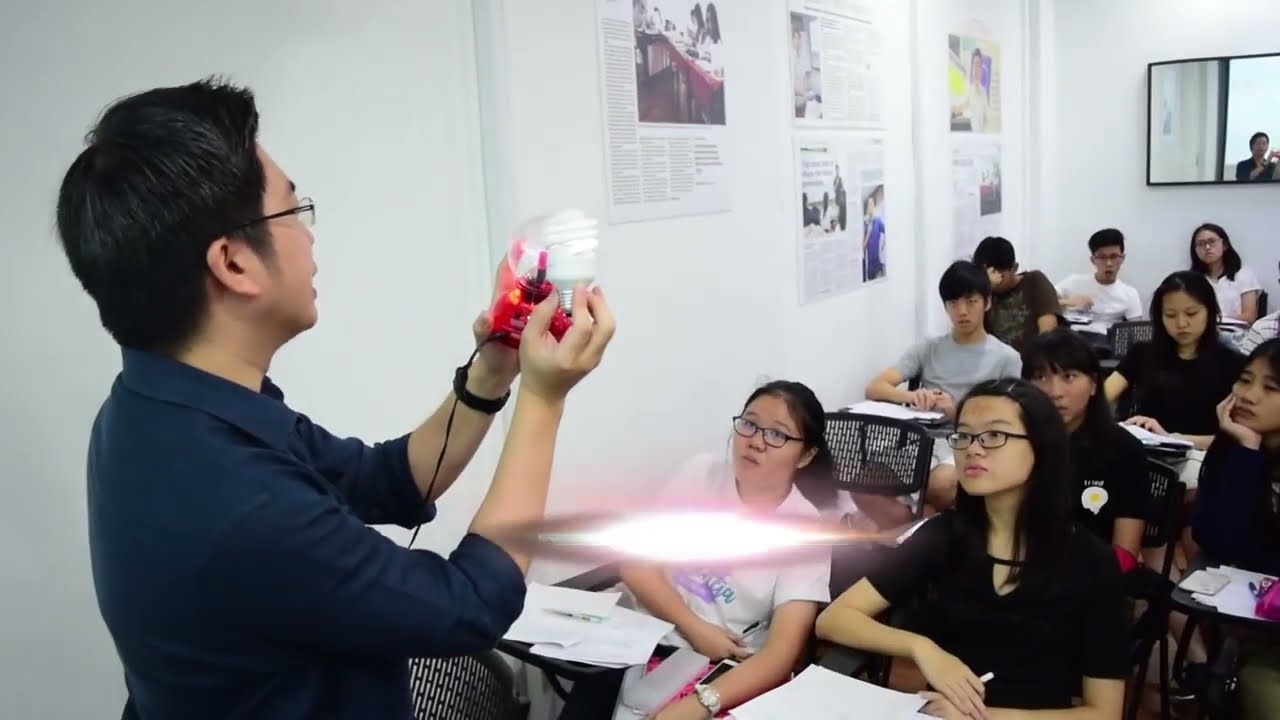
A parent searching for Top Physics Tuition Potong Pasir is often trying to solve a familiar problem: their child finds kinematics and dynamics confusing even after repeated lessons. These topics appear early in Physics, but they influence many later chapters. If the foundation is shaky, students may struggle with motion graphs, forces, energy, momentum, circular motion, and application questions.
The difficulty is understandable. Kinematics asks students to describe motion precisely, while dynamics asks them to explain why motion changes. One deals with displacement, velocity, acceleration, and graphs. The other deals with forces, mass, resultant force, and Newton’s laws. Students who mix these ideas together often feel lost, even though the concepts can be made clear with the right sequence of explanation and practice.
Why Kinematics Feels Confusing
Kinematics introduces several quantities that sound similar but mean different things. Distance and displacement are not the same. Speed and velocity are not the same. Acceleration is not simply moving fast. It is the rate of change of velocity. Students who blur these definitions make mistakes before they reach any calculation.
Graphs add another layer. A displacement-time graph, a velocity-time graph, and an acceleration-time graph each communicate different information. Students may memorise rules such as gradient or area, but they do not always understand what the rule means physically. This is why unfamiliar graph questions can cause panic.
How to Make Motion Graphs Clearer
Motion graphs become easier when students connect the graph to a story of movement. On a displacement-time graph, a horizontal line means the object is not changing position. On a velocity-time graph, a horizontal line means the object is moving at constant velocity. These two horizontal lines look similar but mean different things because the axes are different.
Students should practise describing graphs in words before calculating. Is the object speeding up, slowing down, changing direction, or remaining still? Once the story is clear, the calculation becomes less mechanical. This habit also helps students avoid choosing the wrong equation.
Why Dynamics Is a Different Skill
Dynamics asks why motion changes, so forces become central. A student may know that resultant force equals mass times acceleration, but still fail to apply it because they cannot identify the forces acting on the object. The equation is only useful after the physical situation has been understood.
A common example is a box pulled across a rough floor. Students may remember the pulling force and weight, but forget friction or the normal force. If the pull is at an angle, they may ignore the vertical component. Once a force is missed, the entire calculation can become wrong. This is why diagrams matter so much.
Free-Body Diagrams: The Bridge Between Kinematics and Dynamics
A free-body diagram forces the student to slow down and list every force. Weight acts downward. Normal force acts perpendicular to the surface. Friction opposes motion or attempted motion. Tension acts along the string. Applied force acts in the direction of the push or pull. Once these are drawn, the resultant force becomes easier to find.
This diagram is also the bridge between kinematics and dynamics. Kinematics may tell the student that the object accelerates. Dynamics explains that the acceleration happens because there is a resultant force. When students see this connection, the chapters stop feeling separate.
Common Mistake: Treating Formulas as Shortcuts
Many students try to solve motion questions by scanning for numbers and choosing a formula. This works for simple textbook examples but fails in exam questions that hide information in words or graphs. A ball thrown upward, a lift accelerating, or a trolley moving down a slope all require interpretation before formula selection.
Students should first identify what is known, what is unknown, and what physical condition applies. For example, at the highest point of a vertical throw, the velocity is momentarily zero. That clue may not be stated directly. The student must understand the situation well enough to infer it.
Worked Example: Lift, Weight and Normal Force
Lift questions often expose the difference between memorisation and understanding. A person standing on a weighing scale in a lift has a constant weight, because weight depends on mass and gravitational field strength. Yet the scale reading can change when the lift accelerates because the scale measures the normal force.
If the lift accelerates upward, the normal force must be greater than the weight to provide an upward resultant force. If the lift accelerates downward, the normal force is smaller than the weight. Students who understand this can reason through the question. Students who memorise only weight equals mass times gravitational field strength often become confused.
How Students Can Practise These Topics Better
Practice should begin with definitions and diagrams, then move into calculations. Students should explain the meaning of each quantity, draw motion graphs, sketch force diagrams, and only then use equations. This order builds understanding before speed.
A useful study routine is to take one question and rewrite it in three forms: a word description, a diagram, and an equation. If the student can move between all three, they are learning the physics properly. If they can only substitute numbers, the understanding is still fragile.
Signs That Mechanics Is Starting to Improve
Improvement in mechanics is not only seen through higher marks. Students begin to pause before choosing a formula, draw diagrams without being reminded, state directions more carefully, and explain what a graph means in words. They also become better at checking whether an answer is physically sensible.
These signs matter because they show that the student is building judgement. Mechanics becomes less about hunting for equations and more about understanding motion and force. That shift is what helps students handle questions that look different from the ones they practised.
How TGC Academy Helps Students Build Clarity
TGC Academy in Potong Pasir supports students by breaking difficult mechanics topics into smaller reasoning steps. Instead of treating kinematics and dynamics as formula lists, lessons can help students connect motion, forces, diagrams, and equations. This is especially useful for students who are trying hard but still feel that mechanics questions change too much from one paper to the next.
For Potong Pasir students, regular support also makes it easier to revisit mechanics before the confusion spreads into later topics. When these foundations become clearer, other areas of Physics tend to feel less disconnected.
Frequently Asked Questions
Why do students struggle so much with kinematics?
They often confuse similar quantities such as distance and displacement, or speed and velocity. Motion graphs also require interpretation, not just memorisation.
What is the biggest mistake in dynamics?
The most common mistake is failing to identify all the forces acting on the object. A missing force leads to the wrong resultant force and wrong acceleration.
Are free-body diagrams always necessary?
They are strongly recommended whenever forces are involved. Even a quick diagram can prevent mistakes and may help earn method marks.
How are kinematics and dynamics connected?
Kinematics describes motion, while dynamics explains the forces causing changes in motion. Resultant force and acceleration are the main link between them.
How should students revise mechanics before exams?
They should practise definitions, graphs, diagrams, and calculations together. Mechanics is best revised as a connected set of ideas, not isolated formulas.
Kinematics and dynamics become clearer when students stop rushing to formulas and start reading the physical situation first. With better definitions, diagrams, and reasoning habits, these topics can shift from being a constant source of confusion to a reliable foundation for the rest of Physics.
TGC Academy (Potong Pasir) Location Details
- Business Name: TGC Academy (Potong Pasir)
- Address: 107 Potong Pasir Ave 1, #01-K1, Singapore 350107
- Phone: +65 8920 0792
- Email: [email protected]
- Website: https://www.tgc.sg/
- Operating Hours: Monday, Wednesday, Thursday, Friday: 3:00 PM to 10:00 PM; Saturday: 3:00 PM to 8:00 PM; Tuesday and Sunday: Closed
Google Map Location: